This post is part of the Virtual Conference on Mathematical Flavors, and is part of a group thinking about different cultures within mathematics, and how those relate to teaching. Our group draws its initial inspiration from writing by mathematicians that describe different camps and cultures -- from problem solvers and theorists, musicians and artists, explorers, alchemists and wrestlers, to "makers of patterns." Are each of these cultures represented in the math curriculum? Do different teachers emphasize different aspects of mathematics? Are all of these ways of thinking about math useful when thinking about teaching, or are some of them harmful? These are the sorts of questions our group is asking.
I am excited to write a post as part of a group of bloggers thinking about the tension between problem solving and theoretical understanding, among other tensions. Moreover, the benefit of procrastinating and getting terribly behind is that I get to read and respond to some of the other blogs written as part of this group. Michael's post, in which he discusses the reasons that he has moved away from problem solving as a classroom focus, was one that really struck me and prompted me to want to respond. I think that he makes some excellent points about wanting to move away from answer getting as an inherently inequitable and exclusionary practice in which some students race ahead while others are left behind. It's a great read, and I highly recommend you pause here and read his post in full.
The main place where I found myself disagreeing was in the setup, in which problem-solving is positioned diametrically opposed to theory-building, and the two trade off against each other. This, to me, seems like a confusing and artificial construction... both are just questions that we are posing about the world, where perhaps problem-solving takes the form of slightly more specific questions and theory-building is what we call questions that are more general. Joshua Bowman calls out this false dichotomy in his post as well, adding it to the list of polarities like applied vs. theoretical and individual vs. communal and urging for math teachers to value both types of thinking because we just don't know what's going to motivate or interest a particular student and the more variety and ways there are to be hooked into mathematical thinking, the better.
I would say that as teachers, we can't help but be biased towards ways of thinking that are aligned to how we ourselves think and what we value. When I first started teaching, I was very much tapping into my own personal experiences as a math student - the complete disconnect I had felt from math as an intellectual discipline in high school and why I fell in love with math as an undergraduate, thinking for the first time about real (to me) mathematical questions that sparked my curiosity and wonder and ideas that blew my mind and made me want to learn more. I posed problems to my high school students in the way that I would have wanted them posed to me. There were some kids who came along for the ride, but there were also definitely some who were left behind because I was not speaking their language.
Joshua's conscious choice to provide students with many options and potential hooks is a way to move away from this form of me-centered teaching, which can be such a natural trap. He chooses to be agnostic and let students construct knowledge in the way that works for them. I find it interesting that Michael is perhaps doing the same thing, but in a way that purposefully deemphasizes problem-solving because it is such a dominant paradigm in mathematics so that students are exposed to other ways of doing math. The sentiment behind these teacher decisions definitely resonates for me, and I think should be central in teacher preparation and planning for courses - what values are you emphasizing in your classroom structures, teacher moves, and curriculum?
I have certainly seen problem-solving play out in the same troubling ways that Michael referenced in his post - primarily when I have attended math team practice and felt the anxiety I often feel in these types of hyper-competitive-speed-based-publicly-exposed environments. But for me, it isn't problem-solving that's the culprit, but the types of problems that have been posed, the environment in which they are done, and their purpose. For example, I attended PCMI last summer - this is a place where math teachers are solving problems together for hours every day. There is a huge amount of variety in mathematical background knowledge, experience with math teaching, and familiarity with the PCMI style. Yet norms are set and problem sets written in such a way that connections, representations, deep and novel ways of thinking and analyzing, and thoughtful questions are what is valued, resulting in a community that while not quite a mathematical utopia, is pretty damn close. Good problems + clear norms + teacher moves to support norms = learning that aligns to the values of the program and access and motivation for many students.
In my own teaching, I have moved towards student-posed questions and projects as something that more closely matches my values in teaching and moves away from my subjective opinion of what is interesting towards my students' perspectives and interests. I value good problem posing as an opportunity to both pique interest, stimulate thinking, and help students better understand what makes for a good problem so they can move on from problems posed by me to problems they pose themselves. It's much less important to me if the questions they ask are specific (problem-solving) or more general (theory-building) - it's in the asking of questions and seeking to understand and construct the world around them that I see the purpose of my teaching.
Showing posts with label problem solving. Show all posts
Showing posts with label problem solving. Show all posts
Saturday, August 25, 2018

Friday, March 24, 2017
Task Makeover
We've all been there... you find a task that seems awesome. You start reading it and you get excited. There are so many different strategies that can be tried. There's a visual and algebraic aspect to it and a chance to try specific examples, make generalizations and predictions, test them, and build and justify a model. You spend a bunch of time exploring the different paths you think students might take, how you're going to give them feedback and what you'll assess with this task, how it fits with the rest of your curriculum, how you'll structure individual work time, collaboration and class discussion, how you think the lesson will flow, and how much time you plan to give to each component. Mostly, you're excited because you think it will be engaging and fun for students and will also bring up really interesting and important math ideas and practices. You introduce the task in class, eyes aglow with that special teacher light reserved for days like this, rubbing your hands in anticipation for the awesomeness about to unfold.
Except that it doesn't. At all. Kids seem confused. Then, frustrated. Heads start to go down onto desks along with pencils. Silent think/work time becomes sad, frustrated time, then out-loud complaining time as you slowly realize that this task is bombing and how. The kids you'd especially hoped and planned to engage, the ones who only sometimes engage, are the first ones to go. You try to rally the troops, but it's a lost cause, and you end the class demoralized and humbled. X years into this thing and every day still has the potential for catastrophe and epic failing (you may or may not be exaggerating the dramatic nature of the experience, most kids probably shrugged their shoulders and went on with their lives, but it was a hard 30 minutes for me, dammit!)
Where do you go for solace and a sympathetic ear? To the Math Twitter-Blog-o-Sphere, of course!
Thanks to the advice and thoughtful questions of all you fine folks, I was able to reflect on the task design and recognize that the sheer wordiness and immediate jumping into very abstract ideas was a huge turn-off for many students.


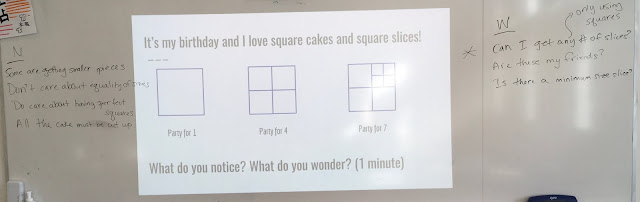
This was a natural segue to asking students what they noticed and wondered, which brought out all the key features of the problem that in the earlier version were laid out in many, many words. Namely - is it possible to throw a party of any size if the slices must be square (but don't need to be of equal size)?



Except that it doesn't. At all. Kids seem confused. Then, frustrated. Heads start to go down onto desks along with pencils. Silent think/work time becomes sad, frustrated time, then out-loud complaining time as you slowly realize that this task is bombing and how. The kids you'd especially hoped and planned to engage, the ones who only sometimes engage, are the first ones to go. You try to rally the troops, but it's a lost cause, and you end the class demoralized and humbled. X years into this thing and every day still has the potential for catastrophe and epic failing (you may or may not be exaggerating the dramatic nature of the experience, most kids probably shrugged their shoulders and went on with their lives, but it was a hard 30 minutes for me, dammit!)
Where do you go for solace and a sympathetic ear? To the Math Twitter-Blog-o-Sphere, of course!
That feeling when you spend hours planning an awesome investigation for students and they hate it... pic.twitter.com/0xg8yIPcrh— Anna Blinstein (@Borschtwithanna) March 21, 2017
Thanks to the advice and thoughtful questions of all you fine folks, I was able to reflect on the task design and recognize that the sheer wordiness and immediate jumping into very abstract ideas was a huge turn-off for many students.

Students had been doing so well with open investigations that even though it had been a little while since we had done one, I had completely abandoned the normal structures that coax kids who are not super sold on this Math thing just yet to try things, engage, take guesses, get a foot in the door, and progress towards increasing abstraction and formality at their own pace.
Fortunately, I had another class the next day with which I had planned to try this task. Back to the drawing board.
I started with a story. It's my birthday, but I'm really, really obsessed with all things square. My entire party has a square theme. Of course, I demand a square cake and that all pieces served to guests are perfect squares too. I can have my own party and eat the entire square cake myself. I can be a bit more generous and have a party for 4 since I can cut the cake into 4 perfect square slices. I can be even more generous and throw a party for 7 by cutting the cake further.


Students immediately had gut reactions and strong opinions. Some were ready to look for patterns right away, but for most, an opening question of: can you make another arrangement that we don't already have on the board? sent them on their way.
Students quickly determined that they could make 1, 4, 9, 16, 25, etc pieces and that they could always add three to the number of pieces by cutting one of them into 4 and add 8 to the number of pieces by cutting them into 9.
There was another breakthrough when a student presented a convincing case for 6 pieces (as well as 11) and others realized that they could always add 5 more pieces by putting another layer on the outside.

This was the class I'd been hoping and prepping for when I found this task. Engaged, arguing, changing their minds, kids working past the end of class and needing to figure this out.
Take-aways for me? Don't assume that kids have graduated past scaffolds that help them get started and build up to abstraction. If you're going to take them away, be aware and think deeply about how to do that carefully and thoughtfully. It's hard to reclaim a class that's lost its confidence so pay attention to this part.
I went back to the first class and tried again. With the reformulated question, things went much better. One of the students who had struggled the most the first day came up with a great organizational chart (that she said was inspired by Pascal's triangle) for tracking possible party sizes.

She did have to amend it when another student came up with the 6 and 11 square versions since her version only assumed you could have perfect squares and add either 3 or 8.

Next step for both classes - helping them transform the patterns and ideas they have into more formal written explanations and justifications.
Friday, August 12, 2016
Formalizing Routines
In my last post, I blogged about #TMC16 and how excited I was to take what I learned in @davidwees's workshop on instructional routines and apply it to what I do most in my class, which is guided investigations (aka problem sets that scaffold instruction) and open investigations, which are more focused on exploring connections and representations of student thinking. I've taken a first stab at writing out the steps and teacher moves involved in both types of investigations (links below), including writing prompts for students and class norms. The class norms were especially tricky to nail down because I've been thinking all summer about how to marry the norms that I learned in Complex Instruction, which are all about valuing different types of participation and making the group a cohesive and supportive unit, with what I'm seeing as emerging from the research on Visibly Random Groupings, which values flow and makes the entire class a unit of idea exchange and interdependence. Complex instruction often has assigned roles within the group and clear instructions on establishing a "group question" before a teacher can be called over for help. By contrast, in a VRG class structure, students are encouraged to share ideas with and ask for help from anyone in the class. Groups change daily and roles are eschewed in favor of flow of ideas and vertical whiteboards that encourage easy participation and engagement.
My attempt to merge these two cooperative structures (as well as my other goals for students) has resulted in the following group norms:
I am going to continue randomly assigning students to groups when working on problem sets or open investigations and avoid assigning roles. There will probably be one day every week or two when students are grouped homogeneously based on their self-assessment of their needs (more structure/support/direct instruction, same level (stay with guided inquiry), explore independently). I have to think about tweaks to the group norms that need to happen on those days.
I also wrote out the protocol for when a group can ask me for help. They need to first attempt the strategies posted in the classroom for getting unstuck (listed below), look around to see what other groups are doing and send a representative to another group to discuss and share ideas, and if they're still stuck, to formulate a single question to ask me... aka a group question. I should be able to ask anyone in the group what their question is and be assured that it was indeed a group decision to get help.
I will try to remember to write another post discussing the various reflection prompts and closing questions that I've adapted, but here are the links to the two routines, which have all of the prompts I've thought of so far.
Guided Inquiry Routine
Open Investigation Routine
Feedback is super appreciated! These are still very much in the planning stages, but it's been immensely helpful to write out and formalize the routines that I normally use in my classes. My goal is to work on making these better this year, both in my classes and in those of my colleagues, through lesson study focused specifically on routines.
My attempt to merge these two cooperative structures (as well as my other goals for students) has resulted in the following group norms:
I am going to continue randomly assigning students to groups when working on problem sets or open investigations and avoid assigning roles. There will probably be one day every week or two when students are grouped homogeneously based on their self-assessment of their needs (more structure/support/direct instruction, same level (stay with guided inquiry), explore independently). I have to think about tweaks to the group norms that need to happen on those days.
I also wrote out the protocol for when a group can ask me for help. They need to first attempt the strategies posted in the classroom for getting unstuck (listed below), look around to see what other groups are doing and send a representative to another group to discuss and share ideas, and if they're still stuck, to formulate a single question to ask me... aka a group question. I should be able to ask anyone in the group what their question is and be assured that it was indeed a group decision to get help.
I will try to remember to write another post discussing the various reflection prompts and closing questions that I've adapted, but here are the links to the two routines, which have all of the prompts I've thought of so far.
Guided Inquiry Routine
Open Investigation Routine
Feedback is super appreciated! These are still very much in the planning stages, but it's been immensely helpful to write out and formalize the routines that I normally use in my classes. My goal is to work on making these better this year, both in my classes and in those of my colleagues, through lesson study focused specifically on routines.
Wednesday, April 29, 2015
My issue with hints
Yesterday, @mpershan asked for feedback on his Shadowcon talk regarding the usefulness of hints.

As much as I agree that hints could be improved by these things, I also have a lot of discomfort around hints in general. Too often, I find that they funnel student thinking in a predetermined direction... as in, the student is stuck, and the teacher is trying to direct them onto a path that they think is productive by using hints, but it's a predetermined path and therefore removes a lot of the exploration that one would presumably want a student doing in solving this problem. Michael argued that this was only true for bad hints, that good hints should not simplify the problem or do the heavy lifting for the student or close off avenues of thoughts and overspecify a direction. I'm still not sure if we're arguing semantics or if we genuinely have different views on whether hints are good or bad and thought it might be helpful to look at specific examples.
Random exhibit A from a recent assignment:
I gave my students a problem of the week from the IMP curriculum in which you are told that there are five bales of hay, but that instead of being weighed individually, they were weighed in all possible combos of two. We know all of these dual weights, but would like to know how much each individual bale weighs.
Lots of students were confused and stuck. Here were some things that I did not say (although I really, really wanted to) because I think of these hints as being too helpful and pushing kids in a certain direction in their problem solving.
Here are some things that I did say:
His contention is that the pedagogy of hints for 9 - 12 math teaching is not very developed and could be improved by thinking about the context, reasons, and specificity of the hints.Would love to hear from you, *especially* if you disagree. An invitation to comment on my #shadowcon15 talk. http://t.co/lCzGmtgXWI— Michael Pershan (@mpershan) April 29, 2015

As much as I agree that hints could be improved by these things, I also have a lot of discomfort around hints in general. Too often, I find that they funnel student thinking in a predetermined direction... as in, the student is stuck, and the teacher is trying to direct them onto a path that they think is productive by using hints, but it's a predetermined path and therefore removes a lot of the exploration that one would presumably want a student doing in solving this problem. Michael argued that this was only true for bad hints, that good hints should not simplify the problem or do the heavy lifting for the student or close off avenues of thoughts and overspecify a direction. I'm still not sure if we're arguing semantics or if we genuinely have different views on whether hints are good or bad and thought it might be helpful to look at specific examples.
Random exhibit A from a recent assignment:
I gave my students a problem of the week from the IMP curriculum in which you are told that there are five bales of hay, but that instead of being weighed individually, they were weighed in all possible combos of two. We know all of these dual weights, but would like to know how much each individual bale weighs.
Lots of students were confused and stuck. Here were some things that I did not say (although I really, really wanted to) because I think of these hints as being too helpful and pushing kids in a certain direction in their problem solving.
- How many times does each bale of hay come up in all the weighings?
- What is the total weight of all of the combos? Why might this be helpful?
- How can you represent this using equations?
- Can you organize the combos in order of weight?
- Are there any combos the weights of which we can figure out? Any that we cannot?
- Can you make equations to represent what you know?
- Can you make a table to organize what you know?
- Can you make an easier version of this problem?
- I see that you have four equations, but five unknowns. How do you think that will play out in trying to solve this problem?
Here are some things that I did say:
- What have you tried?
- Have you talked to anyone else in the class?
- Where are you stuck? How do you know that what you're doing isn't working?
- What information would be helpful to get unstuck?
- What things do you think that you know? What don't you know?
- How are you organizing your thinking?
- How are you representing your understanding of this problem?
- Are you making any assumptions? Which ones? How will you know if your assumptions are correct?
- How will the person reading this understand what you did?
- What are strategies that might be helpful here that you haven't tried yet?
- You are making a lot of progress! Read through what you have already and see if you can restate it in a different way.
I make a distinction between teaching a specific procedure or specific content when you would want to channel students' thinking perhaps more narrowly - there may be multiple paths, but not an infinite number of them, and it is likely important that students understand which paths are more efficient under what circumstances and how they connect to each other - versus when you are asking students to work on a more open problem in which they are meant to develop problem-solving and sense-making. It seems like half the purpose of open problems are for students to come up with different approaches, persevere past sticking points, learn to think flexibly and independently, and make sense of unknown situations. And yes, that almost requires that they be stuck and frustrated for parts of it. If a problem can be solved by a student easily and without any false starts, then it's not much of an open problem. To me, hints like the ones I listed in the first section decrease this cognitive load significantly. I want students coming up with those ideas, not following mine.
I am trying not to get bogged down in the word "hint," but it just has this connotation of "I have the right answer in my head, but you can't figure out what it is so let me make it a bit easier for you to get it." If we redefine "hint" to also include questions or statements that push the student to think more deeply and develop their own internal resources rather than as a way to make the process smoother for them by external means, then I think that I can get behind good hints.
Friday, November 22, 2013
Baby steps
There was a good discussion recently on Twitter about complex tasks and why many teachers and students shy away from engaging with them or give up in frustration and return to low-level tasks.
I think that we can all come up with reasons why it's difficult for many teachers (including myself) to move out of their comfort zones and implement rich tasks in their classrooms. I am also interested in figuring out why students would resist complex tasks. @MathEdnet blogged about the various reasons that complex tasks can empower students by giving them more control and a voice as mathematicians and doers. The idea is that working with rich problems allows students to see their knowledge as valuable and themselves as active users of such knowledge. In implementing such tasks in the classroom, however, I have often seen student frustration and discomfort with the change in expectations from previous classes or from how the class had been functioning. This is sometimes especially true for students who care about their progress the most and who have certain ways of doing mathematics that have worked for them in the past that no longer work in a framework of complex problem solving. For these students, complex tasks appear confusing, unfamiliar, and an obstacle to their goal of doing well in the class. It can feel very frustrating to the teacher, especially if she hopes that implementing a complex task will increase student buy-in and engagement. Everybody is unhappy.

There are many ways of working on this issue, I think, and each is unique to the particular confluence of school, teacher, and group of students. Some teachers have big enough personalities that they can persuade students to trust them and step out of their comfort zones through sheer awesomeness.

Teachers like me who have a hard time not being liked by our students and are not inspiring enough to get everyone to drink the Kool Aid come up with more gentle approaches. Baby steps, if you will. I have been working on a mix of traditional and complex instruction that takes students from the type of work that they're used to doing in math classes and gradually, inserts some open problems, starting with smaller tasks that are worked on in class and give students plenty of supports to hopefully build on more and more rich problems as students' comfort level increases.
I am, by no means, amazing at this. I definitely give tasks that are too open for students to handle and they freak out. Or alternatively, too many low-level tasks, which undo some of the work I've put into pushing them past that point. But this is the type of thing that is really, really hard to learn to do. Or, at least, it is for me. It's not something that is part of a graduate course or can be picked up by watching a lesson or two taught by a master teacher. And I have certainly never seen a pre-made curriculum that does this type of nuanced dance between what this particular group of students is comfortable doing and something that's just a bit outside of their comfort and ability zone so that they feel challenged and interested, but not overwhelmed and frustrated or bored and disengaged. So. My point. I did have one. I feel like lots of us on Twitter are stabbing away at this teaching thing, but with different tools, personalities, and kids. And it's easy to feel frustrated that I'm not doing amazing open tasks every day with my students or month-long cross-curricular projects that empower and engage them to the utmost.

But, I'm working just outside of my comfort zone and pushing my students to do the same. Baby steps. But progress, nonetheless. And I'm confident that y'all are doing the same, in your own way.

Thoughts/critiques of this framework? pic.twitter.com/vsTdBKbOhC
— Geoff Krall (@emergentmath) November 20, 2013
I think that we can all come up with reasons why it's difficult for many teachers (including myself) to move out of their comfort zones and implement rich tasks in their classrooms. I am also interested in figuring out why students would resist complex tasks. @MathEdnet blogged about the various reasons that complex tasks can empower students by giving them more control and a voice as mathematicians and doers. The idea is that working with rich problems allows students to see their knowledge as valuable and themselves as active users of such knowledge. In implementing such tasks in the classroom, however, I have often seen student frustration and discomfort with the change in expectations from previous classes or from how the class had been functioning. This is sometimes especially true for students who care about their progress the most and who have certain ways of doing mathematics that have worked for them in the past that no longer work in a framework of complex problem solving. For these students, complex tasks appear confusing, unfamiliar, and an obstacle to their goal of doing well in the class. It can feel very frustrating to the teacher, especially if she hopes that implementing a complex task will increase student buy-in and engagement. Everybody is unhappy.


Not a teacher, but would probably be an awesome one.
Teachers like me who have a hard time not being liked by our students and are not inspiring enough to get everyone to drink the Kool Aid come up with more gentle approaches. Baby steps, if you will. I have been working on a mix of traditional and complex instruction that takes students from the type of work that they're used to doing in math classes and gradually, inserts some open problems, starting with smaller tasks that are worked on in class and give students plenty of supports to hopefully build on more and more rich problems as students' comfort level increases.
I am, by no means, amazing at this. I definitely give tasks that are too open for students to handle and they freak out. Or alternatively, too many low-level tasks, which undo some of the work I've put into pushing them past that point. But this is the type of thing that is really, really hard to learn to do. Or, at least, it is for me. It's not something that is part of a graduate course or can be picked up by watching a lesson or two taught by a master teacher. And I have certainly never seen a pre-made curriculum that does this type of nuanced dance between what this particular group of students is comfortable doing and something that's just a bit outside of their comfort and ability zone so that they feel challenged and interested, but not overwhelmed and frustrated or bored and disengaged. So. My point. I did have one. I feel like lots of us on Twitter are stabbing away at this teaching thing, but with different tools, personalities, and kids. And it's easy to feel frustrated that I'm not doing amazing open tasks every day with my students or month-long cross-curricular projects that empower and engage them to the utmost.

Wait, this isn't what your classroom looks like every day?
But, I'm working just outside of my comfort zone and pushing my students to do the same. Baby steps. But progress, nonetheless. And I'm confident that y'all are doing the same, in your own way.

So coming back to the original question - perhaps what I'm hoping for is more recognition of baby steps and meeting people where they are, both teachers and students, to help them make small, but noticeable progress, as a way out of the cycle that @emergentmath described.
Sunday, October 27, 2013
Getting students to dig deeper into rich problems
So I was going to participate in the #MTBoS Challenges, but then, life happened. I did write a blog post responding to the first challenge, and even though I'm not participating in the full scope of challenges, I'd like to post what I can. So here is what I wrote in response to the question "What is one of your favorite open-ended/rich problems? How do you use it in your classroom?"
I gave students 20 minutes in class to start working on the problem (5 minutes alone, then 15 minutes with their group members) and a week and a half to complete their write-ups. I also met with students individually who were struggling.
Even though we were directed to write about a favorite rich problem, I’m going to write about a problem that is the most recent one that I’ve done with a class because I’m having some issues with the way it’s worked out and would love some feedback on how to make it better.
The problem that I recently gave my 2-year Algebra students (these are 8th graders in the second year of a 2-year course that covers a standard Algebra 1 curriculum) was the first one in the Integrated Math Program, Year 1 book, called Broken Eggs. This was students’ first problem of the week, in which they are to write up their problem-solving process and justify their thinking and solution, if they find one. In this problem, you are told that a number of eggs when put into groups of 2, 3, 4, 5, or 6 always had one egg left over, but fit perfectly into groups of 7. Students were asked to determine whether there was only one unique solution or whether there were many possible solutions, and if so, how they were connected to each other.
Full problem:
I gave students 20 minutes in class to start working on the problem (5 minutes alone, then 15 minutes with their group members) and a week and a half to complete their write-ups. I also met with students individually who were struggling.
I thought that the problem was a good one with which to start as it could be approached from a variety of angles and would encourage for the looking of patterns. However, the results were pretty disappointing. Most kids were only able to find the first solution and did so using brute force (writing out the multiples of seven and testing each one to see how it divided by 2, 3, 4, 5, and 6). Quite a few kids just looked at numbers that weren’t evenly divisible rather than looking for a specific remainder. Almost no one found any other solutions and not a single student found a pattern between the solutions. Almost no students even attempted to find one. So the problem just turned into one that required some organization to keep track of things, but almost no algebraic thinking. So basically, the result was a lot of annoying calculations with little payoff.
I am trying to think about what I could have done differently to encourage students to keep going and to notice patterns that would make their work easier. Having students share strategies maybe would have helped to disseminate some of the shortcuts that a few of the students discovered, but not ones that no one figured out. I think that part of the tension for me is that I want open problems to really be about students’ thinking and approaches, but also be a learning opportunity that stretches them past their current abilities and into something more advanced, and I don’t know how to do that without giving hints or telling kids to change their approach. Basically, I want them to learn and be stretched mathematically, but have it be organic and come as an extension of their own thinking rather than a top-down approach where I direct them.
Part of the issue also is that kids are mostly to work on problems of the week outside of class so I’m not getting much of a chance to see their thinking before they turn them in to me. So another change that I’m thinking of doing is having students turn in a “rough draft” that I can give them feedback on or that we can confer about in person before they complete their write-up. There is a thin line between pushing a student’s thinking and directing it onto a predetermined path that takes away from the problem’s openness and richness, and I am still navigating how to do this in an optimal way. Suggestions welcome!
Part of the issue also is that kids are mostly to work on problems of the week outside of class so I’m not getting much of a chance to see their thinking before they turn them in to me. So another change that I’m thinking of doing is having students turn in a “rough draft” that I can give them feedback on or that we can confer about in person before they complete their write-up. There is a thin line between pushing a student’s thinking and directing it onto a predetermined path that takes away from the problem’s openness and richness, and I am still navigating how to do this in an optimal way. Suggestions welcome!
Wednesday, August 15, 2012
Integrating problem solving into the curriculum
Like many others (@fawnpnguyen posted recently about her approach and there were some great discussions in the comments), I have wrestled with the question of how to integrate problem solving into my teaching. The master's program through which I was trained as a teacher heavily emphasized students engaging with rich, multi-entry tasks that promoted collaboration, writing, and connections between different approaches and ideas. I strongly believe this type of work should be a vital part of every math class. At some point soon, I hope that the Global Math Department will have a presentation on how to lead/organize problem solving in the classroom. Here are the different ways that I've used rich problems in the past:
- Found problems that connected directly with the content material that was already part of the course.
There are many problems that lend themselves to the content found in traditional MS and HS classes. For example, many of the problems in the Interactive Mathematics Program, Years 1 and 2, lead to students creating rules for specific scenarios or functions, including linear, exponential, and inverse ones. The Mathematics in Context and Connected Mathematics series have some great problems that can be integrated into traditional Pre-Algebra and Algebra 1 classes. The drawback with trying to connect everything back to the traditional content is that there's lots of material for which I have not found good problems, such as factoring, operations with rational expressions, and radical functions and expressions. Back when I taught Algebra 2 and Pre-Calculus, I had similar difficulties finding rich problems for much of the content. There's also the issue of time - I'd like to ideally have at least one rich problem every week or two, which eats up a lot of my class time if done well. Finally, using only problems that have a clear connection to the traditional curriculum leaves out a lot of rich, awesome problems that I still want to include.
- Assigned problems to be completed outside of class. Some were connected to the traditional content, some were not.
This gave me a lot more flexibility in terms of good problems to use and took up much less class time. But I never found a good way to support struggling students, develop the writing and problem-solving skills that are at the core of this type of work, and make explicit the connections between the assigned problems and the rest of the curriculum. The problems gradually petered out as both I and the students lost steam and assigning the problems became stressful and unproductive. If I do this again, I will need to spend some class time teaching students how to wrestle productively with open problems and will probably need to do some ramping, with easier problems at the start of the year.
- Provided problems to interested students outside of class. Not required, problems were usually unconnected to the content.
This was definitely the approach that involved the least amount of work. I had a pretty straightforward system: a folder with copies of the current "Problem of the Week" stapled to the wall outside of my classroom and another folder stapled just below that where students put their completed write-ups. At the end of the week, I would read through the submitted work, write feedback, and award candy to those students who demonstrated good work on the problem. I had a spreadsheet where I kept track of students who completed these. Some positives were that I got kids who weren't even my students to participate, just because they thought it might be interesting, and because it was not required, it was very stress-free and emphasized the "fun" aspect of figuring out math problems. The cons were that there was little connection to the curriculum and the students who participated were those who already enjoyed math and the students who could stand the most to gain from this type of experience avoided it altogether.
So, my thoughts for this school year are that I would like to do all three of these options (hooray for overachievers!). A mix of #1 and #2 make the most sense for my class - doing those problems that have a clear content connection in class & spending more time on them, while reserving those awesome, random problems for the times when I can't find anything good that connects to what we're studying. Option #3 can co-exist as optional, more challenging or more "fun" type problems for students to do just because they want more. My biggest enemy right now is time: time in class for students to discuss and time outside of school for students to think and do math and write up their thinking and mathing. Oh, and did I mention that my students only have math for 45 minutes four days a week??? Clearly, I can't just add on more stuff without cutting anything, so I'm wondering how others have found time to do this - what do you cut?
Wednesday, June 20, 2012
Summer Plans - Curriculum Remix

While this new blogging/twittering (tweeting?) thing has been wonderful, it has also made me overwhelmed with thoughts about what I want to change in my curriculum for next year. I've been working in a bunch of different directions for a few years (some quite contradictory), but I'm hoping to pull a lot of things together this summer and not feel like I'm tinkering at the edges. One of my sad realizations this year when we were moving offices and I cleaned out a giant box of crap I had lugged from my first school where I spent my first year teaching was all of the insane, cool, cutting edge stuff that I was doing then because I had no fear and didn't know any better and was doing the teaching thing completely solo and rudderless. The part that made me sad lay in realizing how much of that stuff has gone away since I've been at my current school and have become normal, established, and, gasp, respectable. In reality, a lot of that stuff did need to go away. I was giving kids really hard problems and open investigations with no scaffolding and support. I jumped from project to project with no follow through or continuity, which just created confusion. Everything was also handwritten and xeroxed (clearly, I hate trees). Not to mention the fact that my classroom management was just so ridiculous that first year that none of my grand curricular plans even had a chance. Since taking a curricular leap backward these past few years, I've been able to get so much better at organizing the day-to-day running of a class and my ability to interact with and lead students, which I know is really important for my development as a teacher. But I'm really ready to bring some of that crazy self back and inject some pow! back into my teaching.
To that end, I've been gathering resources and thinking how I want to restructure the various Algebra courses that I teach. Some things that I'm finding helpful are:
- Connected Mathematics
- Mathematics in Context
- IMP
- Mathscape
- CPM
- CME Project
- Exeter packets
- Park Math
- Harkness resources, such as this
- Stalking everyone else's wonderful math blogs
- Relooking at grad school materials, now with actual teaching experience to use as a lens
Mainly, I want to change from feeling like I'm teaching a traditional curriculum with interesting problems thrown in every once in a while to a legit constructivist approach. But I still want it to feel cohesive and be rigorous. And I want the students to be on board, which means that I have to meet them where they are when they arrive in my classroom and get them to follow me somewhere different. So this will have to be much, much slower than that erratic first year and more intentional too. My plan right now is to start with the big ideas/concepts from each chapter in the book (not ready to ditch the textbook quite yet), and decide on the best sequence (I'm fine with "going out of order") and problem-based entry point for each concept. I need to decide on how many days for exploring and problem-solving and how much procedural practice I still want to include. Another change that I want to make is to tie journaling more directly to our classwork and problem solving, rather than an add-on "reflection" that students do before a quiz or to wrap up the chapter. I am also thinking of diversifying assessments to include more writing and problem solving, which is mainly just a brain switch for me to stop thinking of tests and quizzes as the "real" assessments of what students know and of projects as the intermediate step where they're still learning and making connections.
The nice thing about doing things "normally" at my current school is that I have some cred with students and the department so that they will give me leeway to try things without assuming I have no idea what I'm doing. It also means that I don't have to think as hard about procedural/classroom management/dealing with teenagers stuff because it sort of starts to make sense after all these years (which is its own brand of crazy). I can just focus on my curriculum. So it's on!
I would love to hear from others about how you've made your class more progressive or get recommendations for more curricular resources. As I start the actual reworking, I'll be posting ideas for problems and journal prompts for feedback too.
Thursday, May 31, 2012
End of year projects, Part 2
The projects have begun! I gave them way too many options, but I really wanted to make sure that everyone could work on something that was genuinely interesting to them. I made a big deal of how the quality is way more important than the quantity, that I am looking for deep engagement with the topic, thoughtful work, and clear explanations. After two days, everyone is still working on the original project they chose and seems engaged and on task. The challenge for me, as usual, is how to push kids past their frustration or a "stuck" point without helping too much.
The most popular project has been "Squared Rectangles," just like last year, which I adapted from the Exeter problem sets. Here's one sample (they need to figure out five of these, which get progressively harder):
The most popular project has been "Squared Rectangles," just like last year, which I adapted from the Exeter problem sets. Here's one sample (they need to figure out five of these, which get progressively harder):
Squared Rectangles
They enjoy these a lot, and there's some nice algebraic thinking that comes into play, but it doesn't seem "projecty" enough... there's not really a conclusion to reach, and I don't know that it really pushes them enough out of the box because there's a set method to working them out. In the future, I might just add these to my "puzzle" center that's available to kids throughout the year and call it a day. But maybe they will wow me with their presentation and convince me of their value.
All of the other projects that were picked by kids are adaptations from IMP Year 1 and Year 2 Problems of the Week (Project #1, Project #3, Project #4) . There is also a group making a video about factoring.
Subscribe to:
Posts (Atom)