Showing posts with label conference. Show all posts

Tuesday, July 19, 2016

#TMC16 Recap

I certainly didn’t need another TMC conference to remind myself of the power and specialness of the #MTBoS, but it didn’t hurt either. I think that this year, I needed the professional rejuvenation of seeing everyone in person just a bit more than usual after a difficult year. So my first and foremost task in this blog post is to convey my gratitude to everyone at the conference who made time for me to vent, invited me out to dinner, came to and participated in my session, gave me amazing advice, and was a source of support. It’s amazingly powerful to have a common starting point with a group of people, to pick up where we left off, either from last year, at other conferences, or Internet conversations. There’s no need to explain, to get our bearings, to wade through small talk and establish common ground and trust – these people get me, we’re on the same team, and it’s effin’ going places. There were so many friends with whom I didn’t have a chance to reconnect, unfortunately, but huge shout outs to @davidwees, @park_star, @jaz_math, @MrJanesMath, @AlexOverwijk, @normabgordon, @JamiDanielle, and @crstn85 for helping me unpack the challenges of this year and get excited about the year to come.

Even though the power of the TMC for me is in the relationships, not the workshops, I have to give huge props to @davidwees for completely challenging my notions of professional development for teachers. I have always been of the camp that the less structure, the better, and that our work together should be about discussing best practices, research, and ideas. Let individual teachers determine how to tweak and interpret these ideas for their particular classrooms, on which they are the experts. It turns out, tightly structured practice with specific strategies, seeing and debriefing them from different angles, and trying to do them yourself while getting feedback is pretty damn powerful. I can’t do a three-day morning session justice here, but check out the materials available about two of their instructional routines here, and I really hope that there are videos available for people who were not able to attend since this is really the kind of thing that needs to be experienced to be understood.

On a meta level, I was surprised by how much practice and feedback we (who were mostly very experienced teachers) needed to get halfway decent at a single routine. We saw it demonstrated several times and debriefed these examples, which is generally as good as it gets in PD. But once we tried implementing it ourselves, new issues and questions surfaced and were addressed. David’s focus on improving teaching practice, not individual teachers, was instrumental here to allow us to be vulnerable and know that we were working together to learn how to do something new and not to be judged (either positively or negatively) by our colleagues. Going to internalize the heck out of this and bring this thinking to my work with other teachers in my department and in the PD that I lead.

I feel like I learned several key points about instructional routines themselves from David and his awesome colleagues (yay Jasper and Kaitlin!):
  • Having a good routine frees us to dig deep into the learning, which is extremely counterintuitive for me as my tendency was to assume that structure is limiting and restricting. Nope! Having good guidelines (which can certainly be tweaked for tasks that would benefit from that) means that our cognitive energy is directed solely at learning and the intellectual work at hand rather than trying to figure out expectations and how that learning should proceed. The routine allows students to do more challenging work. It is nothing like the mindless-recipe-following that I imagined.
  • A quick pace and keeping the focus on what we can learn about patterns/shortcuts/whatever the purpose of the routine is makes the activity engaging and mediates students’ relationship with math in a way that honors their thinking, but pushes them to go deeper, see connections, and understand other methods and representations. This allows all students, not just those who intuitively know how to learn math, to access the learning.
  • A routine is not the time to teach something new. Its purpose is to explore students’ thinking, bring out and connect their ideas, and help them represent and synthesize key mathematical ideas. I can certainly “teach” something in a more traditional sense after the routine, but genuinely focusing it on student thinking keeps it engaging and powerful.


Finally (longest blog post everrrrrrr, bless you if you’ve stuck with me for this long), I loved David’s suggestion of using instructional routines as a focal point for lesson study rather than the traditional use of lesson study to develop a content topic. Different teachers working together can develop different lessons around the same instructional routine and then observe each other, give feedback, and improve the routine in their work together, improving their teaching along the way and creating programmatic change, not change on the individual level.

I am planning on working out my own instructional routines for doing guided and open investigations (similar to Exeter problems and Interactive Math Program tasks) since these form the backbone of my class, but could see separate routines being developed for Open Middle problems (paging @math8_teacher), Would You Rather, Estimation180, or Which One Doesn’t Belong. Contemplate then Calculate was basically created with @fawnpnguyen’s VisualPatterns in mind and it feels like @ddmeyer has already created a 3Act routine, so those two are all set. Any others?

I am super, super, super excited about this as creating routines is something that I think I’m decent at (as opposed to creating creative problems/lessons, which I’m absolutely not) and it’s something that can fundamentally improve our practice in a way that sharing one-off “clever lessons” doesn’t (thanks Dylan… such a valuable point). I’ve already committed our department to doing lesson study this year, and we’re in the midst of building a new program and integrating a number of teachers new to the school so this couldn’t have come at a better time. If there are other teachers out there who would like to give feedback on my ideas or collaborate on creating and tweaking instructional routines around guided/open investigations, I would love to hear from you.


So there you have it… my #1TMCthing is to develop two instructional routines and get as many people as I can to collaborate and give me feedback. Ready, set, go!

Wednesday, November 11, 2015

Student meetings for formative assessment

This year is going by in a blur, but I did finally squeeze out a few minutes to blog about something that I've tried this year that I'm really liking. Based on a description in the book, "Creating Cultures of Thinking," I implemented something that the book calls Individual Feedback Sessions (I just call them "regularly scheduled meetings," but sure, pick the fanciest name you think you can get away with), which were created by a teacher profiled in the book. His explanation of this strategy is here, but the gist of it is:

  1. Schedule 20 minute bi-weekly meeting with each student (he recommended meeting with 2 students at the same time, which I would do if I had a more typical class load). I meet with students before school, during lunch, during their free periods (if they overlap with mine), during tutorial, and after school.
  2. Discuss work that the student has turned in during the last two weeks (since the last time you've seen them). Go through their work with them in detail, giving verbal feedback. Either you or the student records a summary of the feedback (I put comments in the online gradebook and ask students to also write some notes in their notebook).
  3. Discuss the student's overall progress in the class, how they're doing incorporating feedback from previous sessions, and ask for questions about the content and for feedback on what you can do to support them better. Follow up on any issues that have come up in class with that student.
I have a schedule of meetings posted on the class page so students know when we're supposed to meet. For students who need a bit of an extra reminder, I have an automated email that emails them the day before our scheduled meeting. It is more work. I do have a much busier schedule during the school day as a result with almost no "free" periods. BUT, I do virtually no grading at home (other than quizzes, which I like to grade more quickly than a 2 week window would allow) AND I feel like students understand my expectations, really hear my feedback, and develop stronger self-advocacy and ownership of their learning. 


Grading papers at home by myself vs. interacting with an actual student about their actual work...
You do the math


Doing this has made it possible for me to assign better problems. I have been using IMP Problem of the Week tasks in my teaching for a long time, but every year, after grading a few write-ups, I became quickly overwhelmed by the sheer volume of grading (how the heck do English teachers do it??) and stopped assigning them. This year, I have already assigned four Problem of the Week write-ups for every class. And graded them all with students. And seen tremendous growth in their ability to describe their process and reasoning. Yes, I do think it's a valuable skill for students to learn to interpret written feedback from teachers, and I plan to do some of this in the second semester (perhaps, I provide written feedback first, then we meet and student explains how they understood it). But in terms of actually understanding and learning from feedback, in person conversations are waaaaaay more effective. Especially when I'm asking students to do mathematical work that they are not used to doing (writing about process, explaining reasoning, providing evidence, using formal notation and clearly annotating work, etc). Overall, I do think it takes more time, but it's much more fun for me and results in more learning for students so I think it's worth it. 

As the semester winds down, I am starting to ask students to give feedback to their own work and to the work of their peers so this is definitely not my only model for feedback. And as always, I'm curious to learn more about others' approaches and ideas on this.

Saturday, July 5, 2014

Reflections on Design Thinking Institute

The is my second blog post reflecting on my experience with the Design Thinking Institute I just attended at The Nueva School. My first blog post on the various icebreakers they used to get us in the right frame of mind is here.

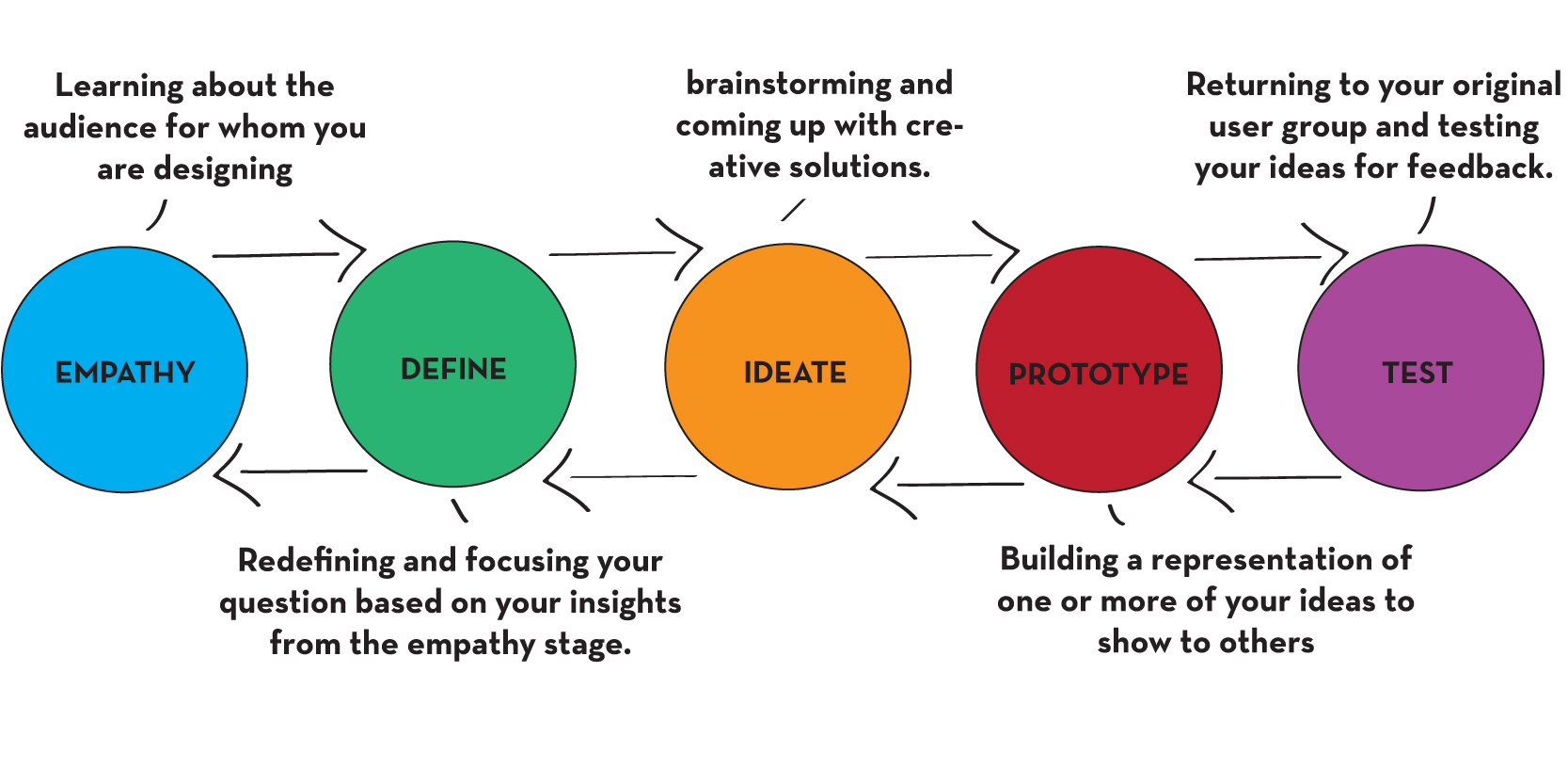
So I won't go into too much detail of what the entire design thinking (DT) process entails, cause it would be impossible to summarize a four day conference like this. There are overviews out there: here and here, and even a TED talk about it. The basic idea is that the designers identify users, research their needs, generate many ideas to address an identified underlying need, prototype one or more of these ideas, get feedback and refine the prototypes, reflect on the feedback and prototypes and make improvements.

Short Version


Long version


You know it's design thinking when there are a lot of post-it notes involved.


Or:

Post-its danced through my dreams by the end of the conference.

The idea for how this applies to education is that this process can be taught to students as a way of framing long-term projects that have application to the real world. For example, students can be asked to design a new playground for their school, design a utopian society, design a catapult, design a way to conserve water, design a way to promote peace in the world, etc. Ideally, projects would connect several disciplines and also tie into something to which the students are connected or care about, allowing them to develop creativity and ownership of the solution process. Other key aspects of the design thinking process emphasize empathy (both for the product's users and for teammates when working with others on a project), thinking outside the box, learning by doing, persevering past obstacles, valuing intuition and informal approaches to learning, and communication skills.


Design thinking in schools looks kind of like this. 


I found it to be a really exciting way to frame projects that is flexible enough to accommodate many different curricula, grade levels, and students. It's easy to use aspects of the process, such as researching or prototyping or reflecting on your progress or brainstorming ideas, and have students focus on learning how to do one or more of them as part of one's curriculum. Ideally, studens would eventually go through the full process to get the full benefits of this type of approach. I also feel like I learned a lot about motivation and how to structure projects while still giving kids independence and ownership of the process. Seeing kids present their ideas with confidence and passion really sold me on the benefits of design thinking as a model. I also see a lot of overlap with the Maker Movement.

I was personally challenged during this conference by having to actually get my hands dirty and make things, which I am not used to doing. There are definitely a lot of connections to math teaching in terms of how we want kids to approach open-ended problems, trying things out and reflecting on how they're working, convincing others that their approach works, and the focus on perseverance and ownership. I talked with a few math teachers about the word "prototype" - it can just refer to "hypothesis" or "idea about an approach or answer" and that in math, we're constantly having students prototype, test, get feedback, revise, and improve.


I do have some hesitation about the fact that part of the design thinking process is that neither the teacher nor the students should have a predetermined solution (or set of solutions) that they are trying to reach. Authentic design thinking is supposed to be about the process and can't be directed towards a known goal. This is a bit tricky in mathematics, where my curriculum IS driven by specific content and I write problems and tasks with particular mathematics content in mind that I want to explore or teach. Not to say that I never give very open problems, but that can't be the case very often or we will not accomplish the learning objectives of the course. In addition, requiring the existence of actual users and a product of some sort constrains the topics to ones that have real-world connections. While I value real-world connections, my favorite math is the kind that is purely a construct in our minds and beautiful because it has absolutely nothing real about it. I don't want to lose sight of mathematics that is abstract and removed from real-life considerations. Abstract math can still lend itself to deep investigations and some aspects of design thinking, but I'm not sure that it can be fully incorporated into the design thinking framework.


Resources for Design Thinking:


The Nueva School is also working on creating a website that will organize some of the resources out there and create a space for teachers to upload their design thinking projects for feedback and use by other teachers. I'll update here when their site becomes available.


Wednesday, July 2, 2014

Icebreakers that teach group norms - accept failure, learn from others, work through frustration

I'm attending a four day conference at The Nueva School on design thinking this week. I'll blog in a bit about the main content of the conference (done!), but I first wanted to get some thoughts down about the activities we did on the first day to build comfort with each other and establish the group norms that would be really vital for the design thinking process. These are centered around empathy for others' points of view, celebration of process over product, and learning through repeated cycles of trying/failing/changing. The activities that we did on the first day of the conference did a great job of both helping participants get to know each other and create a safe space, but also to set up these key aspects of learning without which design thinking isn't possible.

Activity #1:
We started with fun improv games to get people over the fear of doing something silly because hey, we're all doing something silly.

Come get your imaginary points:

We reflected throughout and were explicitly asked to make space for people who hadn't participated as much yet, which I thought was a good thing to do when doing this with students. Basic scenario was: 3 people in the middle of the circle acting out a scene, someone from the audience taps one out and changes the scene. For the last go-round, instead of tapping out, each new person added to the scene, which was a nice way to get everyone included and participating.

Activity #2:
This was perhaps my favorite thing of the day. I really wish I'd gotten a better picture of this, but the basic idea is that each person gets a sheet of paper with two concentric stars, a mirror in a stand, and a piece of cardboard with a cutout for their hand to fit through. Their job is to draw a third star in between the two concentric stars while only looking at the reflection of their hand in the mirror, not at their hand directly.


It looks kind of like this, but if you cut a hole in the cardboard, it's a little easier to draw without looking. But seriously. This activity is amazing for dealing with frustration and failure and getting people on a level playing field. Everyone is just awful at it and it's just about trying over and over again and letting go of perfection. I've also been told that this is a great activity for people who want to know what it's like to be a dyslexic since the entire premise of the activity is fighting the image you see and reinterpreting the visual cues from how you think they look. A great activity to have kids reflect on frustration.

Activity #3:
Two people face each other where only one of them is facing the screen. The one who can't see the screen has paper and a pencil and the one who can see the screen directs the drawer to replicate the image on the screen using only words, no hands (we were told to sit on our hands). I've done activities like this with students because it's really helpful for reflecting on what makes for good communication and how important it is to take the other person's point of view into account (for example, when using directions, like "up" or "right side"). This also deals with frustration, but frustration directed at another person who either isn't understanding you or isn't communicating clearly enough for you to understand and how to work through that.

Activity #4:
This was the first building activity. We were instructed to build the strongest bridge we could out of a single sheet of paper. It had to go across a bin that was about 9 inches across so that meant we had to use pretty much the entire length of the paper. We were given metal nuts to test the strength of the bridge. And go!

People's first attempts looked a lot like this:


It was really cool for me to work on a task that was so open. As a math teacher, I am used to having a lot of constraints that I need to first analyze and understand, lots of equations and thinking done in the abstract and on paper before I'm ready to actually test it with any sort of real-world application. I am very comfortable with tinkering and trying ideas in writing, but I haven't really ever done projects where you make things first. I felt very unmoored and outside of my comfort zone, but I think that it was really good for me because that's how students often feel. It was scary to do something where I had no idea how to start. This is a great activity for helping kids be comfortable with repeated failure and with just jumping in and trying things, as well as for how to look at what others are doing and integrate different ideas or build on each other's approaches. Like all of the other activities, throughout this exercise, we were also told explicitly to reflect on our progress as well as our feelings, which I think is important to remind students to do as well.

This activity reminded me of a bridge-building homework project we had when I was a student in high school. We were given a large number of toothpicks and told to build a bridge that had to withstand a certain amount of weight. But we had only those materials and no more so there was no chance to build prototypes and test, no room for failure. I spent a ton of time on my bridge, but it fell apart immediately on the day of testing. I still remember the feeling of frustration and self-criticism... I had no idea what went wrong and there was no chance to learn from my mistakes and go forward. I decided that I just sucked at making things, which has taken me years to even start to undo. For kids who are perfectionists and fear failure, it is so important to give tasks with low entry points and where failure is accepted and even celebrated, where it's the only way to make something worthwhile. I know that we say this a lot in education, but so many of our tasks and assessments are still one-shot deals. You did it wrong this time = you don't know how to do this. The more opportunities that we can create that are iterative and incorporate feedback and reflection, the more we teach to a growth mindset rather than just giving it lip service.