Monday, September 8, 2014

Formalizing and its challenges

I've really been feeling the tension recently between emphasizing creativity, different ways of thinking, innate mathematical processes that are genuinely student-driven and the type of formal math notation and expression that are needed in order for us to have a common language and to be able to demonstrate our understanding to people outside of our community.

This is the first year in a long time that I'm working with students (7th graders) whose almost entire math learning experience has been rich and validating of the importance of expressing their thoughts and ideas in ways that made sense to them. They have done a lot of open projects and pattern investigations. As a result, they are exceedingly curious and creative in their approaches. They are not into answer-getting, they listen to the ideas of others, and they demonstrate really cool insights and ways of thinking. Having said that, their notation and formalizing of thoughts is ghastly. Their work is just numbers and symbols all over the place, a very personal record that somewhat makes sense to the student writing it, but is incomprehensible to anyone else. Equal signs are placed willy nilly, variables are used with little rhyme or reason to sometimes mean one stage and sometimes mean the previous/next stage, the progression of thought skips blithely around the page in seemingly random directions.

So I'm in a position where I know that I need to teach some formalization of process, some common notation and standardization of the way that we communicate our thinking and show our work. But I want to do this in a way that doesn't destroy the freedom of thought that has been carefully cultivated by their previous teachers, their ownership of mathematics as personal expression. Every time I ask a student to show their work in the very specific, standard way, just like all the other round pegs, I feel a little bit like I'm crushing something wild and pure and free.

It's a math fairy in its natural habitat! Let it run wild and free!

Help me out, teachers of younger students. How do you help students channel their approaches without crushing their spirit? How do I know how much to push formal notation? Our high school does not have an Algebra 1 class so by the end of 8th grade, they are supposed to have learned the equivalent of a standard Algebra 1 class. In my previous school, formal and precise approaches were held in very high regard and students bought in and didn't question it. I received my yearly package of students, some of who maybe weren't so amazing at formalizing their thinking, but were definitely aware that this was a goal for which to strive and gave a reasonably good effort to make it happen. Not so here. I feel like I need to be fully confident and able to justify to these students (and their parents) that what I'm doing is for their best development as students of mathematics. And clearly, I have some doubts at the moment. 

If you teach middle school math, I'd love your thoughts and feedback. How do you get buy in to formalization? My approach so far has been to first let them tackle problems intuitively and then try to demonstrate how to convert that into a more formal way, but their response so far has been a bit of


I feel like I can create some need and urgency to communicate more clearly by having them read and edit each others' work, but that won't likely get them to writing in the standard ways that the rest of the math world shows their thinking. And how to approach formal ways of writing without narrowing their thinking and reducing ownership? Or is that a conflict that's inevitable and just part and parcel of continuing in one's studies as a student of mathematics?

Thursday, September 4, 2014

Digital workflow

In my previous post, I blogged about starting to use Google classroom with my 10th grade students this year. So far, I'm having not the easiest time with figuring out exactly how I want to use it. When you post to your classroom stream, you have the option of posting as an announcement or an assignment. Every time you post an assignment, Google classroom makes a folder with that assignment name and automatically drops work that students turn in into that folder on your Drive. However, students seem to be having a hard time using the "turn in" feature. For the assignment due today, they were supposed to make a spreadsheet of data (using a coin flipping simulator to flip coins and record the number of heads) as well as answer questions about their data. Apparently, Google classroom doesn't appreciate you trying to turn in two things for one assignment. I was told that there's an option to turn in one document and then add another, but I haven't tried this yet. Also, what to do for students who really want to answer the questions by hand?

This brings me to my second question... in the past, I have had students keep a very organized binder with sections. Not quite an Interactive Notebook, but something that could serve as a reference and be easily searchable and reflected upon. I had a great system for managing student workflow and feedback. Now that I'm using Google classroom, I'm trying to figure if I should go completely digital and have students create organized folders in Drive and scan/take pictures of their work or if I should try to maintain a hybrid system of some kind. My goal is for students to be able to compile and reflect on a portfolio of their work, as well as be able to turn in and receive back work in an organized manner. I'm a big fan of systems and right now, everyone is turning things in completely willy nilly and it's driving me crazy. I feel like I have this small window right now while the year is still in formation mode and students are eager to please to create an organized and simple system that makes sense for different types of Math work.


So please, clue me in to your wise ways. If your workflow system has a digital component, I would love to hear about it. How flexible are you? What's your take on helping students be organized? What do you do that you like or don't like? If you went all digital, how did it go? Tell me all of your things!!

Thursday, August 28, 2014

First day of class and starting my stats unit

Tomorrow is my first day teaching at my new school. It's 2 am, I've finally finished working out my lesson plans and I'm way too excited for sleep. I've had a chance to meet most of my students on a pre-term camping trip on Monday and Tuesday, but tomorrow is the first time that we're going to be doing math together. So. Excited. Yay math.

In the interest of greasing the wheels of interdisciplinary work, we decided to start the year for all 10th graders with a statistics unit that will dovetail with work they will be doing in their Biology classes to design experiments and test null hypotheses using chi-square. All sounds awesome, except for the part where I haven't ever taught statistics before and haven't even looked at it since I took it in college myself a long time ago in a galaxy far, far away. Aack. I pestered just about all the stats teachers on twitter with questions, so hopefully, my plan for tomorrow isn't completely wrong and ridiculous. It's mostly adapted from The Pit and the Pendulum unit in IMP: Year 1, but amended to include more technology and be done in one day rather than several.

I have 45 minutes with each 10th grade class. As I usually do on the first day of school, I'm going to project a seating chart of groups and directions for doing a quick, individual writing activity so that I have time to go around, get names, and do administrative start-of-class stuff. This year, I'm going to be trying Google Classroom, so I'm going to have them join the class that I've already set up and complete the first assignment on there, which has a few questions for them to answer. My four questions are:

o   Describe a class that you have really enjoyed – what was awesome about it?
o   Describe a class that you did not enjoy – what was difficult or unpleasant about it?
o   What are some questions that you have about the class?

o   What are some questions that you have about me?

I'm going to collate the results and use them to structure the next few classes. I think that I originally got this idea from @delta_dc, who blogged about it here. I used it last year and I really liked how it transformed the description of the class and its procedures from a passive droning on by me to a more active engagement of coming from student questions.

Once this is done, I'm going to have students pair up within their groups and gather data on their pulse rate. They will record the data in a shared Google spreadsheet and play around with the charts available in there to analyze it. They will discuss in groups, then I will call on specific groups to share out their thoughts. The main discussion topics that I want brought up are:

o   How can we represent this data?
o   What might be interesting to find?
o   How do we expect the shape of the frequency distribution to look? Why?
o   What other variables might be distributed in a similar way? What variables do you think might be distributed differently?

o   Why do we care about shapes of frequency distributions?

I will also try to work in some terminology related to normal distributions, measures of central tendency, samples and populations, and connect this content back to work that they did with probabilities last year. Depending on time, I will ask groups to debrief what makes for good groupwork and good class discussions either today or the next time that we meet because I really want to make sure that there is at least 5 minutes at the end of class for students to do an individual reflection, which they will also share with me through the Google classroom site.

The individual reflection will contain the following questions (students can choose to focus on one, two, or all of these):

o   Something that I found interesting today
o   Something that I found confusing today

o   Something that I’m wondering about that is related to what we did today

This plan seems to contain all of the elements of a first day lesson that are important to me:

  • something to start the class immediately to set the norm that we will start every class period with work
  • a chance for students to share their prior experiences with me, which will help me plan better
  • activities that use individual, pair, group, and class structures so that we can start setting norms for all of these and practice moving from one configuration to another
  • learning of content that's central to the course
  • a few different forms of technology, with which I definitely want students building familiarity
  • end of class reflection
Excited to see how it goes and welcome and would appreciate any feedback!

Actual handout for group investigation:


UPDATE: Woot! Everything went better than expected! Kids were engaged and I got lots of interesting questions through the start of class Google survey. I also spontaneously decided right at the start of the group activity to do a "participation quiz" described by @samjshah, just not as a quiz, but as a way to give feedback to each group. I didn't categorize behaviors and comments/questions as positive or negative, just tried to record what I heard and saw objectively. It gave us a nice jumping off point to discuss group norms.

I did learn that when students complete a Google form that's part of an assignment, Google classroom doesn't count that as having turned in the assignment and continues to tell students that this assignment is due.

Sunday, August 10, 2014

Integrated Curricula - the Good, the Bad, and the Ugly

In working out the details of the Upper School Math curriculum a few weeks ago, we came to a consensus that things would be much more interesting, relevant, and connected if we created an integrated sequence of course that combined the curricula found in geometry, algebra 2, and pre-calculus classes, along with an infusion of statistics, probability theory, programming, and fun math things that are not usually found in standard high school math classes.


After high-fiving ourselves for a bit, we realized that going down this route answers a few questions, but creates about a zillion new ones. Such as, where do we place new students who have already taken one or more of the standard high school Math courses? 


Do we teach all students the same integrated content or do we create "regular" and "accelerated" versions? If we teach the same content to everyone, how do we allow for sufficient support or challenge for students who are either struggling or need more? How do we match up our crazy courses to the standards expected by the University of California board for accreditation? If a student transfers from our school to another one, how will the new school be able to place her into their standard system? How can we convince the rest of the school community that these courses are going to be awesome and worth the hassle?

Apparently, integrated math courses have a reputation as being fluffier or geared towards struggling students (news to me), so we will also have to communicate clearly to everyone why we are advocating for this and how they will benefit and challenge students.

The other issue that is quickly coming to light and making it obvious to me why more schools aren't pursuing this option is how demanding it is of teachers' time and knowledge. Despite my education and teaching experience, I'll be the first to tell you that my knowledge of statistics and programming is pretty minimal. Trying to write either of those two things into the curriculum is a major headache for me... I can lecture on some terminology and have students do examples and exercises, but I don't have the depth of knowledge to write a really awesome activity or project that will be rich and student-centered and exploratory and all the good stuff that I want to be doing in my classroom. Teaching integrated courses requires the teacher to have a much wider net of knowledge and the fluency to weave that knowledge into their teaching. This is really, really hard. 


I feel like non-traditional curricula have more room to go farther in either direction... they can be really, really awesome and exciting and students can learn a ton. But if done badly, they can leave students (and families) frustrated and with large gaps in their knowledge. There's less of a ceiling, but also less of a floor. And that scares me a lot.

People who teach integrated classes: any advice?

Sunday, July 13, 2014

Designing a curriculum: essential questions for Geometry & Algebra 2

I started working at my new school last week and it's been full-speed, non-stop all the way since day 1. I feel like I'm pedaling like mad down one of the steep slopes that are so popular around here and my brakes are broken.

Yup, I live here now

We're in year 2 of a new Upper School and the challenge is to rethink the traditional Math curriculum so that it promotes engagement, interdisciplinary connections, design thinking, and deep content learning without compromising students' ability to do well on the SATs, AP exams, and you know, their future life in a potentially traditional world that may frown upon our hippie ways.

After an amazing day working with Denise Pope, a professor at Stanford's School of Ed and writer of the book "Doing School,"who basically schooled us in the purpose of education, I felt ready to tackle some curriculum writing. She reviewed some of the ideas from backwards design from Wiggins: don't start with activities, but with the desired results. Then, figure out how you will know whether the desired results have been achieved. Then create activities that lead to the desired learning. Her guidelines for selecting enduring understanding goals were:

  • Represents a big idea with enduring value beyond the classroom
  • Resides at the heart of the discipline
  • Geared to students' interests and developmental needs
  • Open-ended, complex, provocative
  • Fits with school standards/expectations

So, I'm putting together my list of "essential questions" and "enduring understandings" for the integrated Geometry/Algebra 2 class that most students at my school will be taking during 9th and 10th grade. Please, please, please give me all of your feedback and criticisms and suggestions for improvement either here or on twitter (@borschtwithanna). I hope that this can be a fruitful springboard for discussion and curriculum framing.

Geometry:
  • How is a system of definitions, postulates, axioms, and theorems created and made cohesive? What does it mean for something to be true?
  • How can objects be transformed? Which of their characteristics stay constant and which change and why? How can we measure and describe what changes? How does this relate to concepts of proportionality and similarity?
  • How are angles on a plane related to each other? How do we know when two lines are parallel or perpendicular to each other?
  • How can we do algebra on a coordinate plane?
  • What is congruency? How do we know when figures are congruent to each other? Why might that be useful to know?
  • How can you determine whether a triangle is isosceles or equilateral? Why might that be useful to know?
  • What are some special relationships for right triangles? How do they relate to polygons? Why might this be useful to know?
  • What can we measure about figures? How do we measure these qualities? How do measurements change when we change dimensions?
  • What relationships are formed when lines intersect circles? 

Algebra 2:
  • What are the underlying principles of solving equations? How do we solve specific kinds of equations: linear, absolute value, quadratic, exponential, radical, and rational?
  • How are equations and inequalities related to each other? How are inequalities represented graphically? How are inequalities solved?
  • What are functions? How can they be represented and what do they represent? How can they be combined or reversed, algebraically and graphically? Why might any of this be useful?
  • What are the key characteristics of the following specific functions: linear, absolute value, quadratic, exponential, logarithmic, radical, and rational? How can we represent situations using specific functions?
  • What are asymptotes? How are they related to graphs and to equations of functions?
  • How are functions transformed? What is the relationship between the equation of a function and its graph?
  • How do functions model data? How do you know if the model is accurate?
  • How can multiple constraints be represented with systems? How can systems be solved?
  • How can expressions be simplified? How can expressions be combined or operated upon? How can expressions be factored? Why might any of this be useful?
  • What are different ways to categorize numbers? How are the different categories of numbers related to each other? How can different categories of numbers be represented graphically? How can we perform operations on different categories of numbers?
  • What are polynomials? What operations can be performed on them and how? How can they be represented graphically? How are their roots related to their graphs and equations? How can their end behavior be described and related to their graphs and equations? Why might any of this be useful?
  • What are properties of exponents and logarithms? Why are they true? How are exponents related to radicals?
  • How can sequences and series be described and evaluated? How are recursive and explicit formulas different from and related to each other? How are arithmetic and geometric sequences different from each other? How do we know whether a series diverges or converges? 
  • What are the measures of variation and how are they computed? Why might they be useful?
  • What are the measures of central tendency and how are they computed? Why might they be useful?
  • How can probabilities of events be determined? How are theoretical and experimental probabilities different from each other? 

* I should add that I haven't forgotten about mathematical practices, habits of mind, etc. We are planning to assess on a common set of these that will be the same across all of the math courses. Just breaking that up into a separate post.

Saturday, July 5, 2014

Reflections on Design Thinking Institute

The is my second blog post reflecting on my experience with the Design Thinking Institute I just attended at The Nueva School. My first blog post on the various icebreakers they used to get us in the right frame of mind is here.

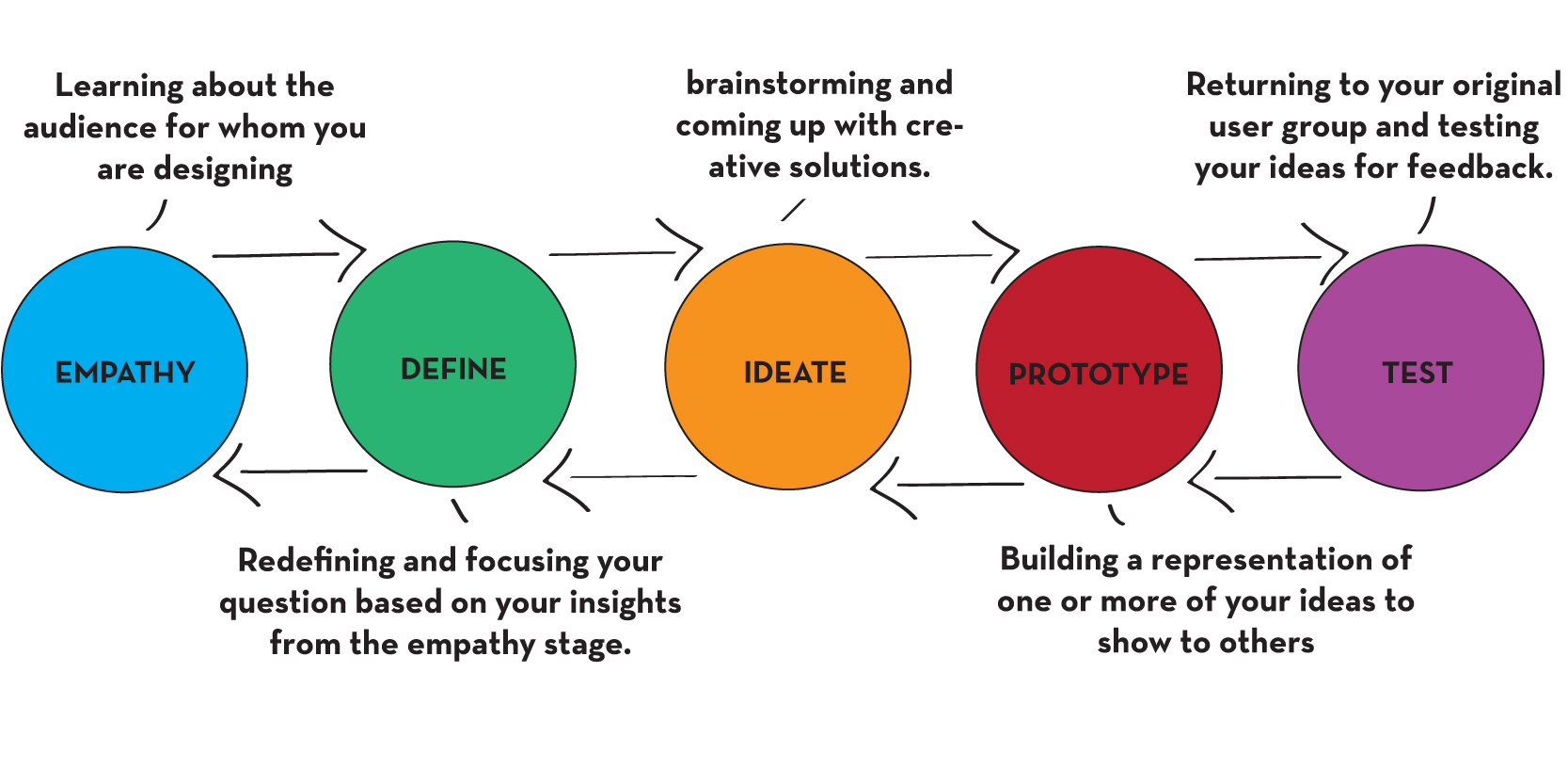
So I won't go into too much detail of what the entire design thinking (DT) process entails, cause it would be impossible to summarize a four day conference like this. There are overviews out there: here and here, and even a TED talk about it. The basic idea is that the designers identify users, research their needs, generate many ideas to address an identified underlying need, prototype one or more of these ideas, get feedback and refine the prototypes, reflect on the feedback and prototypes and make improvements.

Short Version


Long version


You know it's design thinking when there are a lot of post-it notes involved.


Or:

Post-its danced through my dreams by the end of the conference.

The idea for how this applies to education is that this process can be taught to students as a way of framing long-term projects that have application to the real world. For example, students can be asked to design a new playground for their school, design a utopian society, design a catapult, design a way to conserve water, design a way to promote peace in the world, etc. Ideally, projects would connect several disciplines and also tie into something to which the students are connected or care about, allowing them to develop creativity and ownership of the solution process. Other key aspects of the design thinking process emphasize empathy (both for the product's users and for teammates when working with others on a project), thinking outside the box, learning by doing, persevering past obstacles, valuing intuition and informal approaches to learning, and communication skills.


Design thinking in schools looks kind of like this. 


I found it to be a really exciting way to frame projects that is flexible enough to accommodate many different curricula, grade levels, and students. It's easy to use aspects of the process, such as researching or prototyping or reflecting on your progress or brainstorming ideas, and have students focus on learning how to do one or more of them as part of one's curriculum. Ideally, studens would eventually go through the full process to get the full benefits of this type of approach. I also feel like I learned a lot about motivation and how to structure projects while still giving kids independence and ownership of the process. Seeing kids present their ideas with confidence and passion really sold me on the benefits of design thinking as a model. I also see a lot of overlap with the Maker Movement.

I was personally challenged during this conference by having to actually get my hands dirty and make things, which I am not used to doing. There are definitely a lot of connections to math teaching in terms of how we want kids to approach open-ended problems, trying things out and reflecting on how they're working, convincing others that their approach works, and the focus on perseverance and ownership. I talked with a few math teachers about the word "prototype" - it can just refer to "hypothesis" or "idea about an approach or answer" and that in math, we're constantly having students prototype, test, get feedback, revise, and improve.


I do have some hesitation about the fact that part of the design thinking process is that neither the teacher nor the students should have a predetermined solution (or set of solutions) that they are trying to reach. Authentic design thinking is supposed to be about the process and can't be directed towards a known goal. This is a bit tricky in mathematics, where my curriculum IS driven by specific content and I write problems and tasks with particular mathematics content in mind that I want to explore or teach. Not to say that I never give very open problems, but that can't be the case very often or we will not accomplish the learning objectives of the course. In addition, requiring the existence of actual users and a product of some sort constrains the topics to ones that have real-world connections. While I value real-world connections, my favorite math is the kind that is purely a construct in our minds and beautiful because it has absolutely nothing real about it. I don't want to lose sight of mathematics that is abstract and removed from real-life considerations. Abstract math can still lend itself to deep investigations and some aspects of design thinking, but I'm not sure that it can be fully incorporated into the design thinking framework.


Resources for Design Thinking:


The Nueva School is also working on creating a website that will organize some of the resources out there and create a space for teachers to upload their design thinking projects for feedback and use by other teachers. I'll update here when their site becomes available.


Wednesday, July 2, 2014

Icebreakers that teach group norms - accept failure, learn from others, work through frustration

I'm attending a four day conference at The Nueva School on design thinking this week. I'll blog in a bit about the main content of the conference (done!), but I first wanted to get some thoughts down about the activities we did on the first day to build comfort with each other and establish the group norms that would be really vital for the design thinking process. These are centered around empathy for others' points of view, celebration of process over product, and learning through repeated cycles of trying/failing/changing. The activities that we did on the first day of the conference did a great job of both helping participants get to know each other and create a safe space, but also to set up these key aspects of learning without which design thinking isn't possible.

Activity #1:
We started with fun improv games to get people over the fear of doing something silly because hey, we're all doing something silly.

Come get your imaginary points:

We reflected throughout and were explicitly asked to make space for people who hadn't participated as much yet, which I thought was a good thing to do when doing this with students. Basic scenario was: 3 people in the middle of the circle acting out a scene, someone from the audience taps one out and changes the scene. For the last go-round, instead of tapping out, each new person added to the scene, which was a nice way to get everyone included and participating.

Activity #2:
This was perhaps my favorite thing of the day. I really wish I'd gotten a better picture of this, but the basic idea is that each person gets a sheet of paper with two concentric stars, a mirror in a stand, and a piece of cardboard with a cutout for their hand to fit through. Their job is to draw a third star in between the two concentric stars while only looking at the reflection of their hand in the mirror, not at their hand directly.


It looks kind of like this, but if you cut a hole in the cardboard, it's a little easier to draw without looking. But seriously. This activity is amazing for dealing with frustration and failure and getting people on a level playing field. Everyone is just awful at it and it's just about trying over and over again and letting go of perfection. I've also been told that this is a great activity for people who want to know what it's like to be a dyslexic since the entire premise of the activity is fighting the image you see and reinterpreting the visual cues from how you think they look. A great activity to have kids reflect on frustration.

Activity #3:
Two people face each other where only one of them is facing the screen. The one who can't see the screen has paper and a pencil and the one who can see the screen directs the drawer to replicate the image on the screen using only words, no hands (we were told to sit on our hands). I've done activities like this with students because it's really helpful for reflecting on what makes for good communication and how important it is to take the other person's point of view into account (for example, when using directions, like "up" or "right side"). This also deals with frustration, but frustration directed at another person who either isn't understanding you or isn't communicating clearly enough for you to understand and how to work through that.

Activity #4:
This was the first building activity. We were instructed to build the strongest bridge we could out of a single sheet of paper. It had to go across a bin that was about 9 inches across so that meant we had to use pretty much the entire length of the paper. We were given metal nuts to test the strength of the bridge. And go!

People's first attempts looked a lot like this:


It was really cool for me to work on a task that was so open. As a math teacher, I am used to having a lot of constraints that I need to first analyze and understand, lots of equations and thinking done in the abstract and on paper before I'm ready to actually test it with any sort of real-world application. I am very comfortable with tinkering and trying ideas in writing, but I haven't really ever done projects where you make things first. I felt very unmoored and outside of my comfort zone, but I think that it was really good for me because that's how students often feel. It was scary to do something where I had no idea how to start. This is a great activity for helping kids be comfortable with repeated failure and with just jumping in and trying things, as well as for how to look at what others are doing and integrate different ideas or build on each other's approaches. Like all of the other activities, throughout this exercise, we were also told explicitly to reflect on our progress as well as our feelings, which I think is important to remind students to do as well.

This activity reminded me of a bridge-building homework project we had when I was a student in high school. We were given a large number of toothpicks and told to build a bridge that had to withstand a certain amount of weight. But we had only those materials and no more so there was no chance to build prototypes and test, no room for failure. I spent a ton of time on my bridge, but it fell apart immediately on the day of testing. I still remember the feeling of frustration and self-criticism... I had no idea what went wrong and there was no chance to learn from my mistakes and go forward. I decided that I just sucked at making things, which has taken me years to even start to undo. For kids who are perfectionists and fear failure, it is so important to give tasks with low entry points and where failure is accepted and even celebrated, where it's the only way to make something worthwhile. I know that we say this a lot in education, but so many of our tasks and assessments are still one-shot deals. You did it wrong this time = you don't know how to do this. The more opportunities that we can create that are iterative and incorporate feedback and reflection, the more we teach to a growth mindset rather than just giving it lip service.